POS sales do not match the bank deposit: build a settlement bridge
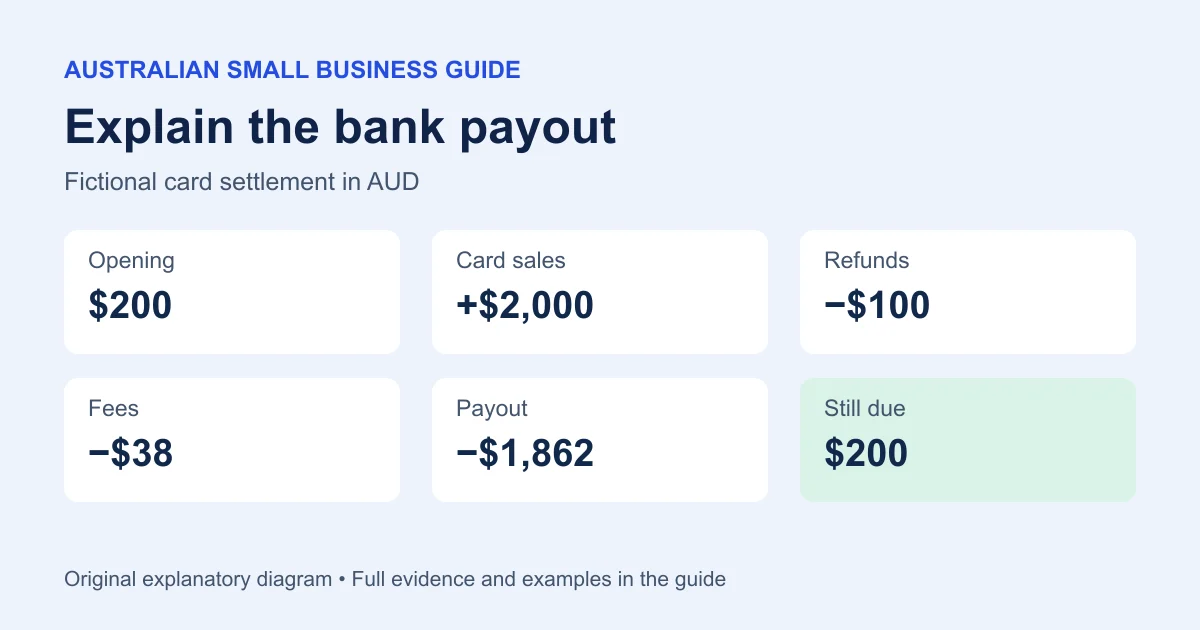
A card payout rarely equals the till's total sales. Reconcile the completed card payments included in that payout, then account for refunds, deducted fees and timing differences. Leave cash sales in their own reconciliation. The remaining difference should be explained by named transactions or adjustments, rather than posted to a miscellaneous expense to make the bank match.
What you’ll get from this guide: Explain the deposit and identify the exact payments still waiting to settle.
A card payout rarely equals the till's total sales. Reconcile the completed card payments included in that payout, then account for refunds, deducted fees and timing differences. Leave cash sales in their own reconciliation. The remaining difference should be explained by named transactions or adjustments, rather than posted to a miscellaneous expense to make the bank match.
Open the sales export, provider transfer detail and bank entry together. This comparison starts with the point-of-sale (POS) system you already use.
Identify the status and reporting window first
Check whether the provider has sent a payout or is still holding the balance. A payout marked pending belongs in the outstanding list until the next event is confirmed. Record the location, currency, timezone and cutoff of each report. A calendar-day sales summary and a payout batch can include different transactions.
Square lets you inspect the individual payments in a transfer and export its details. Use those IDs to establish membership of the batch. Don't infer membership just because a sale has the same date as the deposit.
Build a bridge with the timing difference visible
| Movement | Amount | Evidence |
|---|---|---|
| Opening unsettled card balance | $200 | Prior-day payment IDs |
| New completed card sales | +$2,000 | Today's card export |
| Refunds deducted | −$100 | Refund IDs in this settlement |
| Processing fees deducted | −$38 | Provider fee lines |
| Bank payout | −$1,862 | Bank entry and transfer reference |
| Closing unsettled balance | $200 | After-cutoff payment IDs |
Original ASBG worksheet with fictional AUD figures. The table is also the text equivalent of the example.
The movement check is $200 + $2,000 − $100 − $38 − $1,862 = $200. The $1,862 payout includes $200 from the previous day and excludes $200 from today's late transactions. If the shop also took $300 cash, that $300 never enters this bridge. These are fictional amounts, not a provider's rates or a tax calculation.
The same figures can support a merchant clearing account: record card collections against that account, then clear the documented refunds, fees and bank transfer. Its closing $200 should agree with the provider money still due. Use the accounting workflow your bookkeeper has set up; an integration may already have posted some of these entries.
Check the deductions before posting anything twice
A monthly terminal-rental debit paid separately from the bank does not reduce this payout. A processing fee shown both as a total and as a breakdown is one charge. Match refund IDs too: a refund submitted today might be funded by a later deduction or a separate debit.
If the bridge is $20 out, find the missing $20 event. Check incomplete tenders, excluded locations, returned transfers and duplicate imports. Preserve the unresolved item with an owner and follow-up date. Square's transfer troubleshooting guide identifies location and bank-account checks when the expected funds cannot be found.
Carry the balance forward and close the exception
Tomorrow's opening balance should be today's explained closing balance. Keep the supporting transaction list, not only the total. Once the late payment appears, match it to that list and mark it cleared. An ageing unsettled item needs investigation even when new sales make the total look plausible.
Use the missing-payout checklist if the bank receipt itself is absent. For a confirmed hold, keep a separate reserve schedule. The bookkeeping guide covers the wider bank reconciliation; the payments hub groups the other payment problems.
Key takeaways
- Compare the transactions included in a payout, not two unrelated totals.
- Keep cash, separately paid charges and unsettled card money visible.
- Carry forward an identified balance instead of inventing a balancing expense.
Print or copy the evidence checklist
Copy the template, save a text file for offline use, or print this page with its examples and sources. Fill in your own copy and check it before relying on it.
Settlement bridge
Period and timezone:
Location / merchant account:
Opening unsettled balance:
Completed card sales:
Refunds and documented deductions:
Processing fees deducted here:
Payout reference / amount:
Closing unsettled balance and transaction IDs:
Unexplained difference / owner / follow-up date:
Where to get help
Did this guide help you finish your task?
Optional feedback helps us see which guides need more work.
Feedback is off while site analytics is unavailable or disabled.
We report your choice and this guide’s page through site analytics. Your analytics preference applies. About feedback and privacy.
Where to go from here
Card payout missing: trace the batch before contacting support
Trace the payout when the bank receipt itself is missing.
3 min readMerchant reserves and payout holds: reconcile funds not yet released
Keep restricted funds separate from a routine settlement delay.
3 min readDo processing fees come back after a refund? Check your statement
Continue the “explain the bank deposit” reading sequence.
3 min read
General information only. This guide doesn't take your personal or business circumstances into account and isn't financial, legal or tax advice. Rates and thresholds change — check the official sources linked in this guide and get qualified advice where your circumstances require it.