Read your merchant statement: work out the real card cost
Your effective card acceptance cost is the total of the relevant fees divided by the card value processed over the same period. Start with the transaction charges, then add terminal rental and other acceptance costs once. Keep the original category breakdown so a cheaper month doesn't hide a change in the cards customers used.
What you’ll get from this guide: Calculate a repeatable monthly acceptance cost and identify unexplained fees.
Your effective card acceptance cost is the total of the relevant fees divided by the card value processed over the same period. Start with the transaction charges, then add terminal rental and other acceptance costs once. Keep the original category breakdown so a cheaper month doesn't hide a change in the cards customers used.
Use this worksheet to check an existing bill before requesting a new quote. You'll need the merchant statement, the agreed fee schedule and invoices for any charges billed separately.
Start with the period and the denominator
Write the start and end dates on your worksheet. A statement covering August processing may be debited in September; comparing that debit with September sales mixes two periods. Use processed card value, not total shop revenue or the smaller bank deposit after fees.
Check whether the provider's volume is gross of refunds. Retain its definition alongside your calculation and use the same definition next month. A zero-volume month has a dollar cost, but no meaningful percentage rate.
The RBA explains the components of merchant service fees: interchange, scheme fees and the provider's margin. You won't necessarily see each component separately on a flat-rate bill. Don't add an informational breakdown to a fee that already includes it.
Follow a fictional statement into the worksheet
 Open full-size illustration
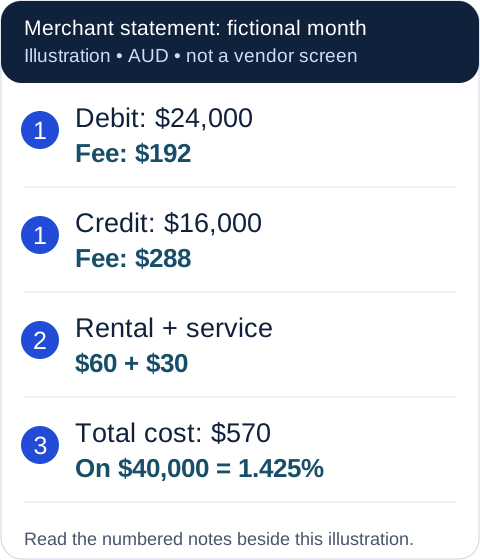
- Debit processing: $24,000 at 0.8% costs $192. Credit processing: $16,000 at 1.8% costs $288.
- Transaction charges total $480. Add $60 terminal rental and $30 acceptance service fee once: $570.
- $570 divided by $40,000, multiplied by 100, is 1.425%. This blended internal cost is not a permitted surcharge calculation.
Original ASBG illustration with fictional data. This is a neutral example, not a provider screenshot. The numbered notes contain the same information as the image.
Here every amount uses the same billing basis, and there are no refunds, disputes or adjustments. The category rates stay separate: $192 / $24,000 is 0.8%; $288 / $16,000 is 1.8%. Allocating all $90 of fixed fees to both categories would count them twice.
Decide what belongs in this comparison
Include fees needed to accept the payments you're measuring. Keep optional POS subscriptions, one-off hardware purchases and staff time on separate lines if you want a wider checkout budget. Record whether quotes include GST and ask the provider about unclear fee treatment; don't assume every charge has the same tax basis.
If a credit reverses a previous month's billing error, show it as an adjustment rather than concluding that processing suddenly became cheaper. Compare both the amount paid and the recurring cost without the correction.
Ask about the lines you can't explain
Send the provider the fee label, statement month and amount. Ask what triggers it, whether it is included elsewhere and which transaction category it relates to. Request the answer in writing so the next person checking the books can repeat the calculation.
The RBA has published October 2026 surcharge-change FAQs. Your provider's acceptance fee and a surcharge charged to a customer are different amounts. Check current terms before changing customer charges; this worksheet measures your own costs.
Use the finished breakdown to compare two pricing proposals. If you also need a new till, keep the POS comparison beside the fee worksheet and browse the payments and POS hub for the operational checks.
Key takeaways
- Match the fee period to the processed card volume.
- Add each fixed charge once and preserve the card categories.
- Explain credits, refunds and excluded costs before comparing months.
Your working checklist
Copy the template, save a text file for offline use, or print this page with its examples and sources. Fill in your own copy and check it before relying on it.
Month and reporting dates:
Processed card value by category:
Transaction count by category:
Transaction fees:
Terminal rental:
Other acceptance charges:
Credits and adjustments:
Total comparable cost / processed value x 100:
Excluded costs and unanswered fee lines:
Where to get help
Did this guide help you finish your task?
Optional feedback helps us see which guides need more work.
Feedback is off while site analytics is unavailable or disabled.
We report your choice and this guide’s page through site analytics. Your analytics preference applies. About feedback and privacy.
Where to go from here
Flat card rates vs itemised pricing: compare your payment mix
Apply the same transaction basket to each quote.
3 min readLeast-cost routing: check what your provider enables
Check whether debit routing changes the amount on your bill.
3 min readBest POS Systems in Australia (2026): Fees and Hardware
Explore a related question linked in this guide.
21 min read
General information only. This guide doesn't take your personal or business circumstances into account and isn't financial, legal or tax advice. Rates and thresholds change — check the official sources linked in this guide and get qualified advice where your circumstances require it.